
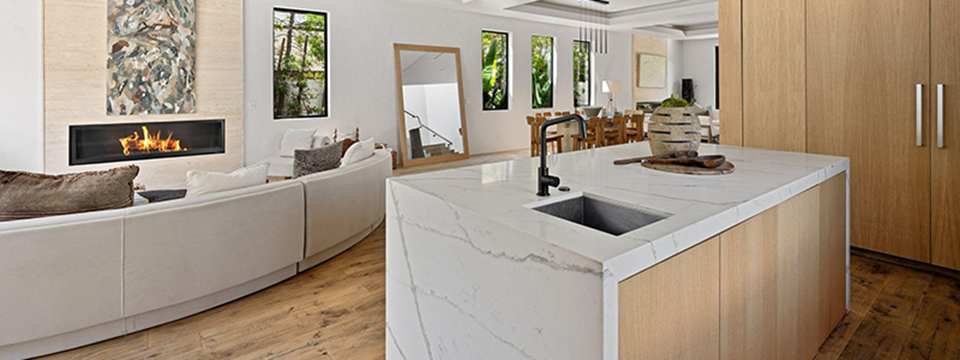
1. Scale Changes Everything
Walk into a space clad in large-format slabs and something shifts—quietly, but decisively. Joints disappear. Lines dissolve. The room feels… uninterrupted.
Is it just size? Not quite. It’s continuity.
- Fewer seams create a monolithic visual field
- Veining flows across surfaces like a single composition
- Spaces feel larger—sometimes deceptively so
Small tiles divide. Large slabs unify. That’s the difference. And once you notice it, it’s hard to go back.
2. Aesthetic Impact: From Surface to Statement
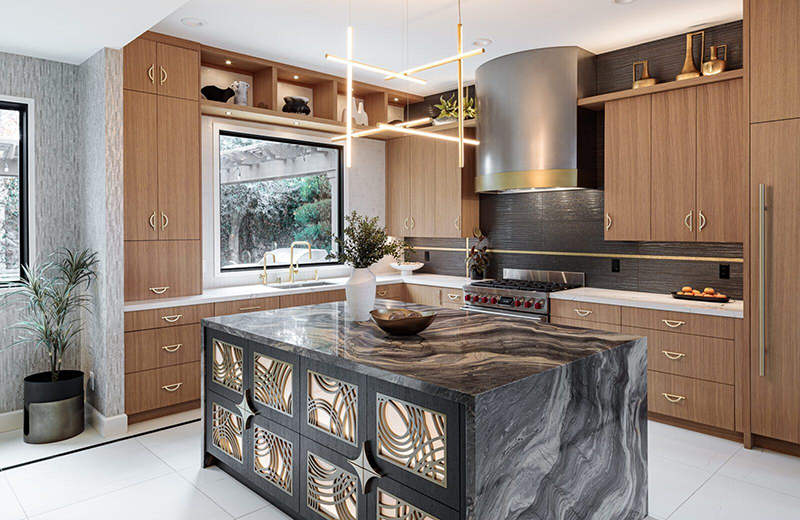
Large slabs don’t behave like traditional materials. They don’t “cover” a surface—they define it.
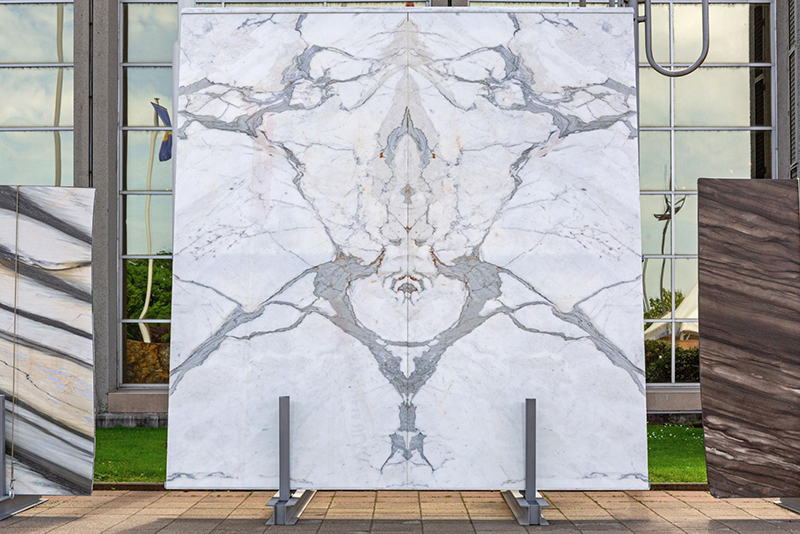
A bookmatched marble wall can feel almost symmetrical, like an inkblot unfolding across the room. A waterfall island made from a single quartzite slab? It reads as sculptural, not functional.
Where the impact becomes obvious
- Feature walls that act as visual anchors
- Kitchen islands where the material wraps continuously
- Bathrooms that resemble spa-like stone enclosures
At this scale, stone stops being background. It becomes narrative.
3. Performance and Practical Trade-Offs
Of course, scale comes at a cost. Not just financially—logistically.
Large-format slabs are impressive. They’re also demanding.
What changes behind the scenes
- Transportation becomes riskier—one mistake, one crack
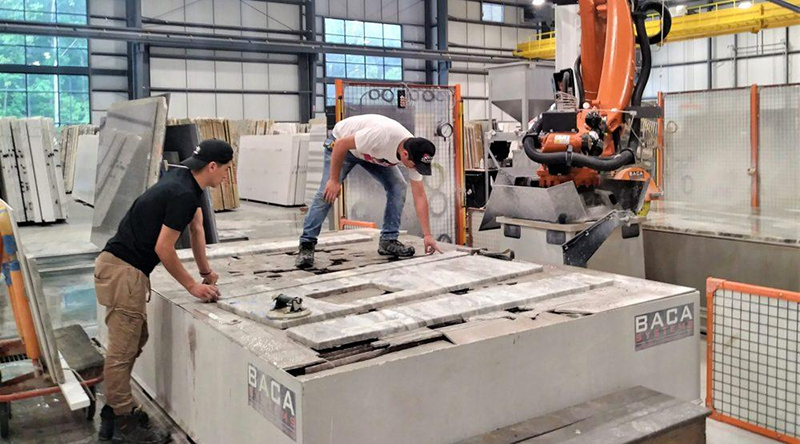
- Installation requires precision, equipment, and experience
- Structural support must be carefully calculated
And then there’s thickness. Go thinner, and you reduce weight—but increase fragility. Reinforcement becomes necessary. Go thicker, and costs climb.
So, are they practical? Yes. Effortless? Not even close.
4. Market Direction: Trend or Long-Term Shift?
Large slabs are everywhere right now. Showrooms, exhibitions, high-end projects. But is this just a phase?
Look closer.
Architects are specifying them more frequently. Developers are investing in them. Fabricators are upgrading equipment to handle them. That’s not what a short-lived trend looks like.
Signals pointing to longevity
- Demand for seamless, continuous surfaces
- Growth in high-end residential and hospitality projects
- Advances in cutting, transport, and installation technology
It’s less about fashion—and more about capability catching up with ambition.
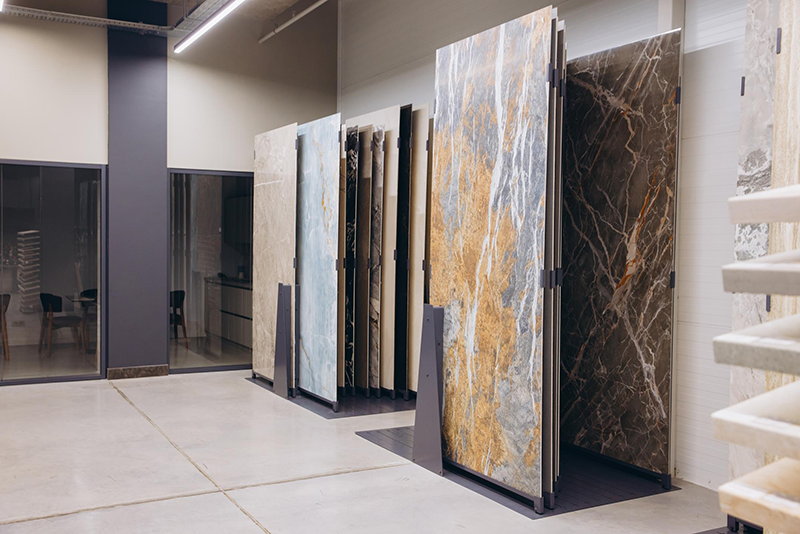
Conclusion
Are large-format stone slabs the future of interior surfaces?
Not entirely. Smaller formats still have their place. Constraints exist—budget, logistics, structure. But the direction is clear.
When design prioritizes continuity, scale, and visual impact, large slabs offer something difficult to replicate.
They don’t just fit into a space.
They redefine it.